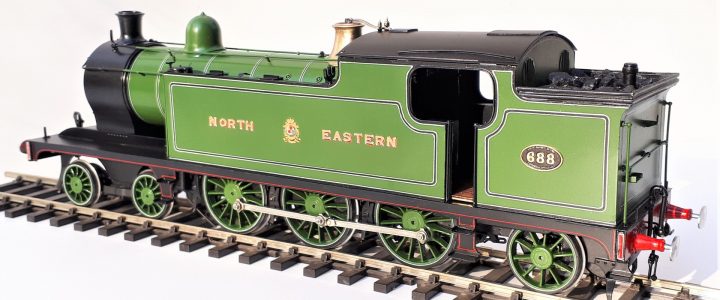
North Eastern Railway class W 4-6-2T no. 688. Built by myself, predominantly from a spare set of nickel silver etchings from Nick Dunhill, but as is always the case, a fair amount of the build had to be from scratch. Most lost wax castings are from the Laurie Griffin range, including the representation of static inside motion. Wheels are Slaters and the motor and gearbox unit are from ABC. The lovely paintwork, with lining by bow pen, has been expertly applied by John Cockcroft. Number plates by Diane Carney. The etches were collected from Nick at Kettering 2019, work started on the 28th May 2019 and was completed on the 10th February 2020, with 125 hours booked for the build, exclusive of painting.
LNER (ex NER) J72 class 0-6-0T no. 524. Built circa 1966 by Wally West using wheels turned from good quality castings, probably by Miller, Swan & Co. The split axles and insulated spacers between the frames allow power to be collected through the non-insulated wheels and frames to the Pittman type motor and gears. All brake blocks are made from non conductive material to eliminate shorting across the brake rigging. All loco axles have sprung hornblocks. Originally painted by brush, believed by Wally Mayhew, in fully lined LNER black livery. This lovely little model has seen some use, but still works well and is shown on Arthur Dewar’s layout in Jack Ray’s book ‘Model Railways and their builders’ published by Atlantic Press. The original care worn paintwork has now been stripped by myself and been repainted exactly as it was by John Cockcroft, at the request of the West family.
Midland Railway 0-4-4T passenger tank no. 1832. Built circa early 1970’s by Wally West using a set of pantograph milled parts produced by Ron Spiers and wheels turned from very good castings, probably by Miller, Swan & Co. The split axles and insulated spacers between the frames allow power to be collected through the non-insulated wheels and frames to the John Hart RM type motor no. 1048. All brake blocks are made from non conductive material to eliminate shorting across the brake rigging. All loco axles have sprung hornblocks. Superbly painted in fully lined Midland Railway passenger livery by Bernard Miller.
LNER D49 (Hunt) Class 4-4-0 no. 366 The Oakley. Built circa early-sixties from scratch by Wally West using non-insulated wheels turned from good quality castings, probably by Miller, Swan & Co. The split axles and insulated spacers between the frames allow power to be collected from the tender wheels and transferred to the loco via strong springs, which also represent water hoses under the fallplate. The motor and 12:1 gears are of the short Bonds type. Power is also collected by plunger pick-ups on the driving wheels. All brake blocks are made from non conductive material to eliminate shorting across the brake rigging. All loco driving and tender axles have sprung hornblocks. Originally painted by Wally Mayhew in fully lined LNER passenger green livery the model had a hard life, but still works well and is shown in use on Arthur Dewar’s layout in Jack Ray’s book ‘Model Railways and their builders’ published by Atlantic Press.The model has recently been stripped of it’s tired and chipped paintwork and has now been repainted by John Cockcroft into fully lined LNER Darlington green livery. It retains the same name, but now proudly carries new nameplates from Diane Carney.
Manage Consent
To provide the best experiences, we use technologies like cookies to store and/or access device information. Consenting to these technologies will allow us to process data such as browsing behaviour or unique IDs on this site. Not consenting or withdrawing consent, may adversely affect certain features and functions.
Functional
Always active
The technical storage or access is strictly necessary for the legitimate purpose of enabling the use of a specific service explicitly requested by the subscriber or user, or for the sole purpose of carrying out the transmission of a communication over an electronic communications network.
Preferences
The technical storage or access is necessary for the legitimate purpose of storing preferences that are not requested by the subscriber or user.
Statistics
The technical storage or access that is used exclusively for statistical purposes.The technical storage or access that is used exclusively for anonymous statistical purposes. Without a subpoena, voluntary compliance on the part of your Internet Service Provider, or additional records from a third party, information stored or retrieved for this purpose alone cannot usually be used to identify you.
Marketing
The technical storage or access is required to create user profiles to send advertising, or to track the user on a website or across several websites for similar marketing purposes.