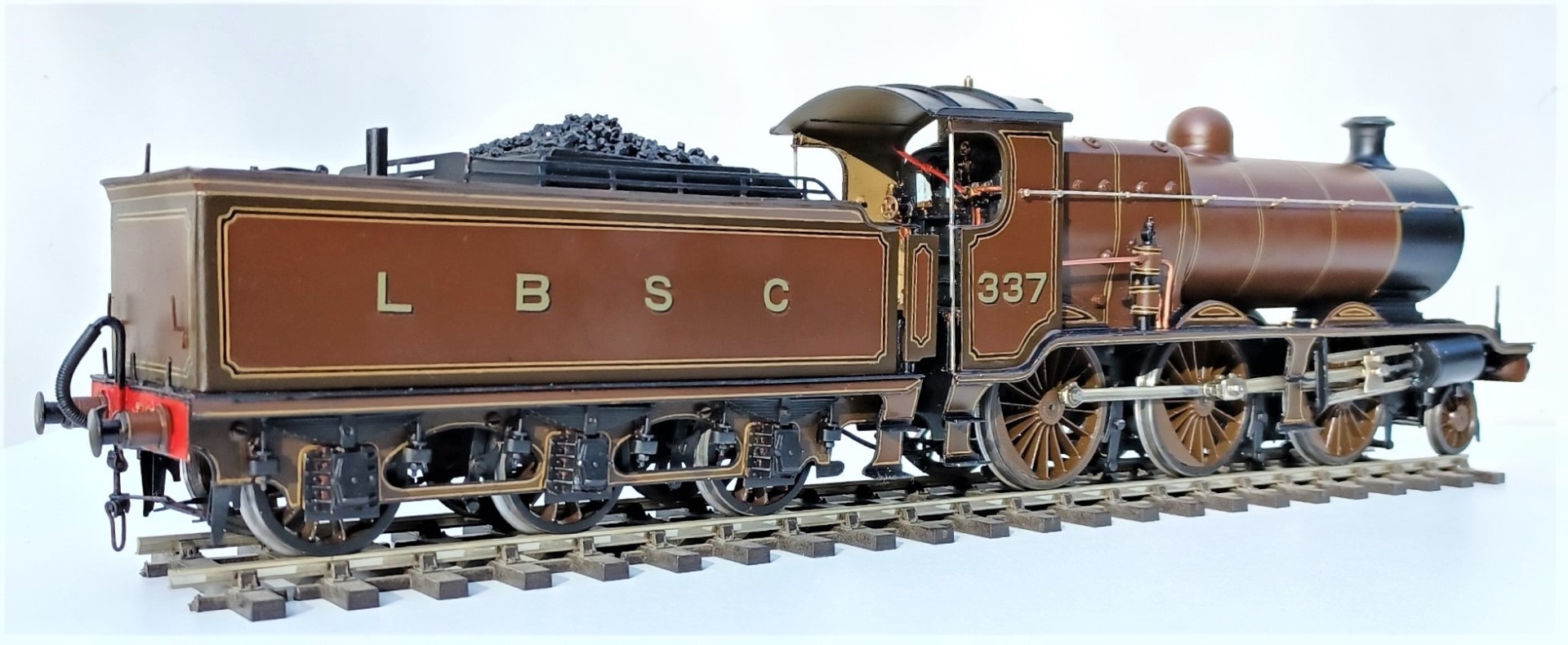
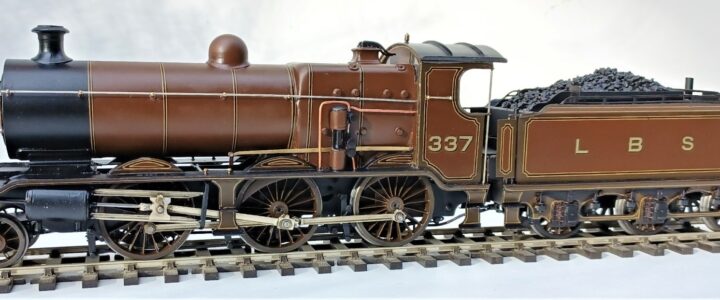
London Brighton & South Coast Railway K class 2-6-0 no. 337. An elderly model of a rare to see prototype which has now been restored into a rarely modelled livery. Originally well built from the Ace etched brass kit by J. Dinnage, this was acquired from auction and has been stripped down, the loco rebuilt with Slaters wheels and an ABC motor and gear unit. Now repainted in the very attractive Marsh umber livery by John Cockcroft. Designed in 1913 by Mr. Billinton, these attractive locos were painted in the LBSC plain black goods livery, until in 1923, probably to use up old paint stocks, number 337 and two others of the class were outshopped in this passenger umber, a livery singularly suited to the class.
BR rebuilt West Country 4-6-2 no. 34010 Sidmouth. This model has been built from the excellent David Andrews kit by Richard Pogson, with an ABC motor and gearbox and Slaters wheels. Expertly painted and lightly weathered by Richard himself. It was taken as part payment for the two SECR O1 class models. Richard is a good friend of mine who helps me a lot, generally with modelling problems that I feel are beyond my capabilities (a very useful bloke to know). When Sidmouth was offered to me with Richards provenance, I had no hesitation.
LNWR A class 0-8-0 compound no. 2545. Built from scratch in 2006 by Bill Davis, (a good friend of mine for many years). I’m now very happy to own such an unusual example of his fabulous craftsmanship. He has built this model of a 3 cylinder compound prototype with a working representation of the inside low pressure cylinder. It took him 192.5 hours to build and it cost the client £2,200. The Alan Harris (AGH) wheels and crank axle alone cost £609.75. Fitted with an ABC Mini S /Maxon motor and gear unit, collecting power by the American system. Most castings are from the Hobby Horse range. Expertly painted by John Cockcroft.
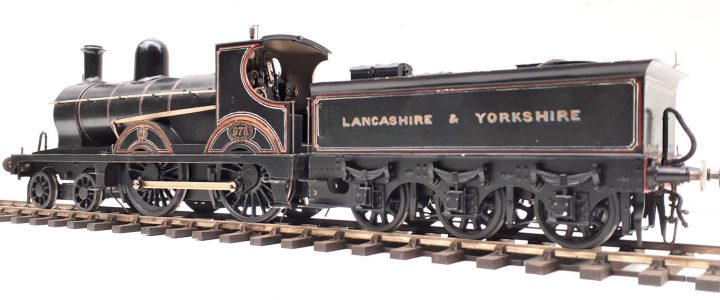
Lancashire and Yorkshire Railway Barton Wright/Aspinal 6′-0″ 4-4-0 (nicknamed a “Peacock”). Beautifully built from scratch and painted by Gordon Heywood in 1963, provenance painted on the underside of the running plate. I didn’t realise that build quality like this was achievable in the sixties, other than by the famous names of Stanley Beeson and Bernard Miller. The crests, all lettering and lining have been painted by hand and the quality of the etched cabside number plates and the “Beyer Peacock & Co.Ltd. Manchester 1883” builders plates, shaped around the opening of the leading coupling rod splasher, is superb. The livery is still in very good condition for such an early model and the detail inside the cab is also superb. The wheels have been expertly machined from good quality cast iron blanks and I believe the motor and gears are home made.
LNWR Webb 5′-6″ 2-4-2T no. 338. This model has been built from the Mercian kit by Nigel Smith, with full and working Joy valve gear, giving excellent movement in the space between the frames and below the boiler. Painted to an exceptional standard by Ian Rathbone, it carries his little red nameplate below the running plate as provenance.This superb model is for sale. If interested in buying, see the models for sale https://www.7mmloco.co.uk/shop_new/page of this website.
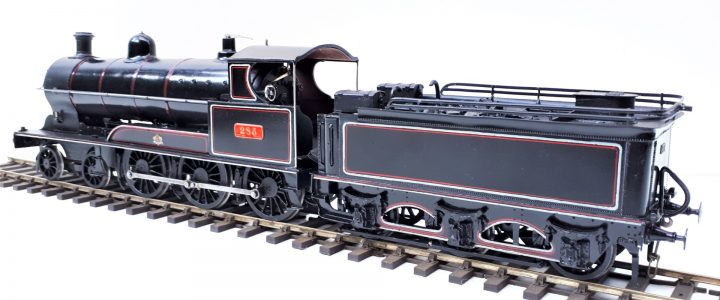
LNWR 19″ goods 4-6-0 no. 285. A fine model, expertly built from scratch with detailed and working crank axle, inside connecting rods, crossheads and slidebars giving very good movement in the space between the frames and below the boiler. The builder is unknown, but it is known that this lovely model used to be part of the Frances Pearce of Malton collection and was often displayed on LNWR Society tables at exhibitions. The paintwork is still good, with excellent contrast of textures between the dull paint of the smokebox and the polished paint of the boiler cladding. The grey, white and red lining is well executed by hand, probably with bow pen. The boiler bands are tape or transfers. Power to the recently replaced motor and gears (now a fuse protected Portescap RG7) is via the American method, together with a single plunger pickup on the loco as the belt to the braces and it also allows the loco to be tested without the tender.
GCR 8F class 4-6-0 no. 1097 Immingham. This lovely model has been very well built by Peter Honeybone for Gladiator Models from the Gladiator kit. Peter built many models for Gladiator Models during the days when Geoff Stratford was the proprietor of the company. Painted in the GCR green and crimson passenger livery. A livery that the original loco only carried in service from when new in 1906 to March 1909, when it was repainted in the mixed traffic black livery. The model has Slaters wheels and an ABC gearbox, with current collection by wiper pickups.
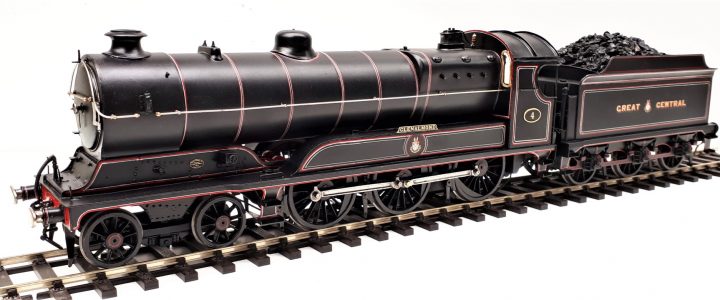
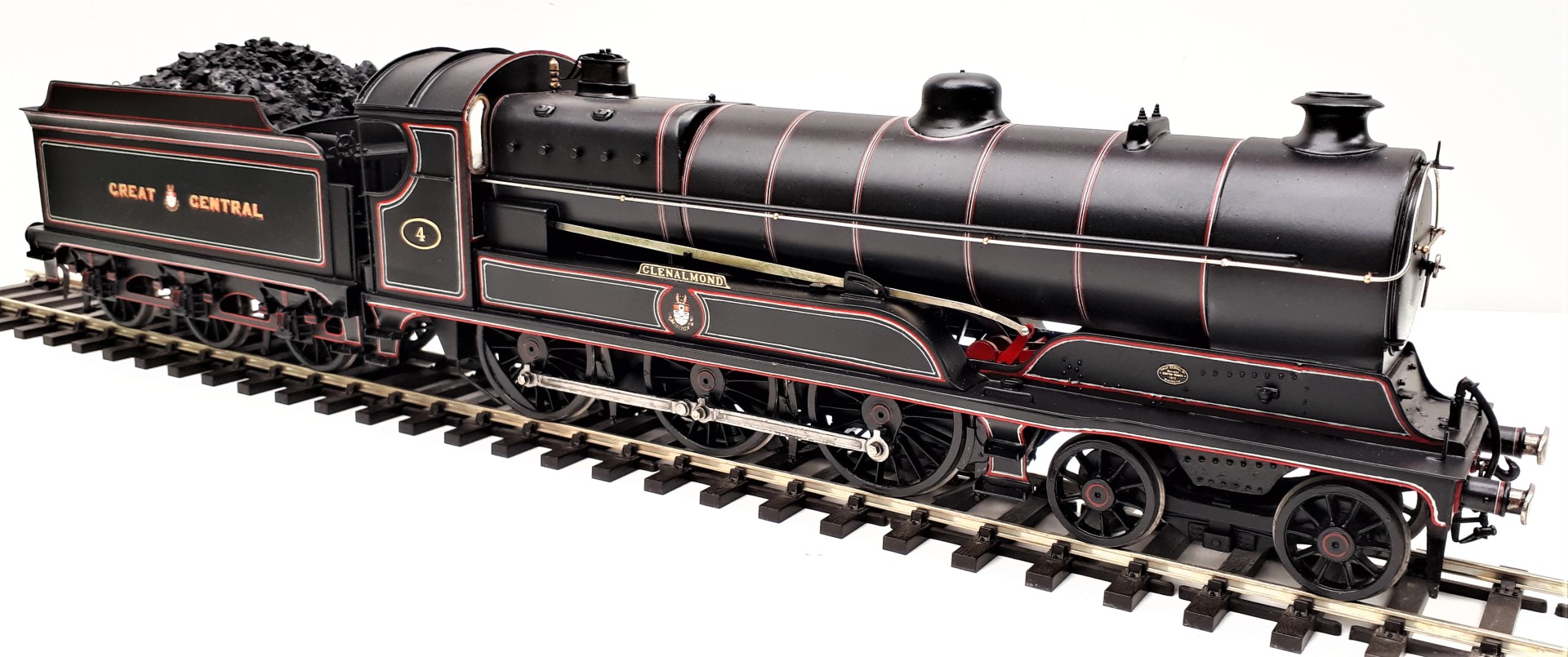
Great Central Railway 1A class 4-6-0 no. 4 Glenalmond. Bought at auction, this model, built from the Gladiator kit, looked good in it’s original LNER lined black livery, but when closely inspected had many hard to see parts missing. However, after stripping the paint, making minor repairs, adding the missing parts and a fabulous repaint by John Cockcroft, in the GCR mixed traffic lined black livery, it is now a very impressive model indeed. Slaters wheels, Portescap RG7 protected by a fuse, powered by the American method of current collection.
LMS (ex Midland Rly) 1F class 0-6-0T no. 1706 (half-cab). Very well built and painted in the LMS goods livery with straw coloured letters and numerals. It has been built from etched brass (or nickel-silver), but not from a kit. The builder has etched the initials “JB” and an unrecognisable logo into the underside of the body of the loco, which looks vaguely familiar. John Brierley is a well respected scratch builder who certainly had the capability to design his own etches, but the only work of his that I have seen before is of southern pre-grouping prototypes. Whether John built this or not, it is still a lovely little model with an ABC gearbox, Mashima motor, Slaters wheels with wiper pick-ups. This loco is for sale, see the models for sale page of this website.
GWR 61xx class 2-6-2T (Large Prairie) no. 6157. This model is by Lee Marsh Model Co. and was constructed and painted in South Korea with switchable DC/DCC control with sound, the switch being easily accessible via the opening smokebox door. The build quality and paint finish (cellulose) is second to none and the model, although second hand, is still in absolutely mint condition. Until I acquired it I don’t think it had even been out of the box.