BR (ex LMS) Royal Scot class 4-6-0 no. 46148 The Manchester Regiment

BR (exLMS) Royal Scot class 4-6-0 no. 46148 The Manchester Regiment. Extremely well built and detailed, from the David Andrews kit by John Taylor of Halifax. AGH (Alan Harris) cast wheels and an ABC motor and gear unit. A very impressive model which I recently found in auction and have been lucky enough to acquire for my collection. When purchased, this model was portrayed as 46156, but at that time I already had a model of rebuilt 46156 and as the paintwork was not up to the quality of the build, I stripped it for a repaint and a new identity and you see the result here, courtesy of Warren Haywood. I must say that this repaint has transformed this well built model to a particularly attractive loco.

BR (ex LMS) Stanier Jubilee class 4-6-0 no. 45705 Seahorse

BR (ex LMS) Stanier Jubilee class 4-6-0 no. 45705 Seahorse
BR (ex LMS) Stanier Jubilee class 4-6-0 no. 45705 Seahorse.Well built from the Gladiator kit, powered by a Portescap RG7 motor and gear unit, with Slaters wheels and current collection by plunger pickups on each of the six driving wheels. Beautifully painted, lined out and weathered by Warren Haywood. The inspiration for me to buy an existing model, strip the paint, carry out any necessary repairs or improvements, before asking Warren to repaint it, came from a trainspotting trip to Manchester with my schoolmate Mark Hulme. At Patricroft shed, we were pleasantly surprised (these were the days when most remaining Jubilees were stored wrecks) to come across Seahorse, with yellow stripe, nameplates and fairly clean. Well worth a few quick snaps with my Kodak Instamatic. I now find that the loco was a celebrity, used regularly on the Buxton services, hence the replacement (probably wooden) nameplates and clean condition. WOW, is an expletive commonly used these days as part of the description for a very average Ebay item. In 1965, we were well and truly wowed by this loco.

LNER (ex GNR) Ivatt class D3 4-4-0 no. 4302

LNER (ex GNR) Ivatt class D3 4-4-0 no. 4302
LNER (ex GNR) Ivatt D3 class 4-4-0 no. 4302. This model has been well built in nickel silver from scratch. I bought this some months ago, on line from Footplate trains in an unfinished and unpainted condition. Originally built with a noisy motor, I have now fitted an ABC motor and gears unit. Good cab detail from scratch, cast iron wheels and a very clever hand made wiper pick-up unit, she is a very smooth performer indeed. Painted by John Cockcroft, doesn’t she look good ? A rare prototype to see modelled as no quality kits are available of a loco of this type.

GWR Armstrong class 4-4-0 no. 8 Gooch as running between 1903 to 1905

GWR Armstrong class 4-4-0 no. 8 Gooch as running between 1903 to 1905
GWR Armstrong class 4-4-0 no. 8 Gooch as running between 1903 to 1905. This model was what I call a “basket case”. One of the superb Modern Outline Kits. There could be many of these kits around, where the original buyer/builder has bitten off more than he can chew, realising the complexity of this kit is beyond his skills. Probably placed in a wardrobe waiting for him to build his confidence to give it another go.
It has now been completed by myself to a smooth running condition, and painted by Warren Haywood. Slightly different to other MOK Armstrong class models on these pages. Notice fenders on the tender sides, not coal rails. Lamp irons, not lamp sockets. Different clack valves. All features as seen on archive photos of the prototype. Driven by a Portescap RG7 motor/gear unit. Unfortunately the crankshaft and connecting rods were missing/lost before I acquired the model, so, although it does have slide bars and crossheads, there is nothing there to drive them.
The descriptive notes above explain why I can afford to offer this lovely model for sale at roughly half the price that I have sold similar models to this of top quality. It is not a perfectly built model. Don’t expect it to negotiate tight curves or to pull heavy loads, but it has been built square and true and is very good value for money for one of these magnificent MOK Armstrong class models.


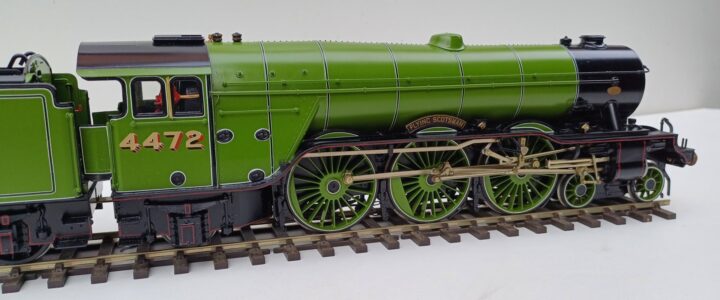
LNER Gresley A1 class 4-6-2 no. 4472 Flying Scotsman

LNER Gresley A1 class 4-6-2 no. 4472 Flying Scotsman
LNER Gresley A1 class 4-6-2 no. 4472 Flying Scotsman. A Limited Edition factory built model by DJH, with its original box and certificate. Slaters wheels, a chain driven motor/gear unit and power collection by plunger pick-ups. Modelled as running for the LNER’s “The Flying Scotsman” non-stop train during the period between 1929, when the loco was paired with a corridor tender, and 1935, when the cut-outs on the cab sides were reduced in size. In my opinion, DJH used to produce models to a superb build quality, but the final finishing is sometimes slightly less so (eg vacuum hoses painted light grey and safety valves painted gold). Since buying this model I have made one or two tweeks to the paint to bring it up to my standard.

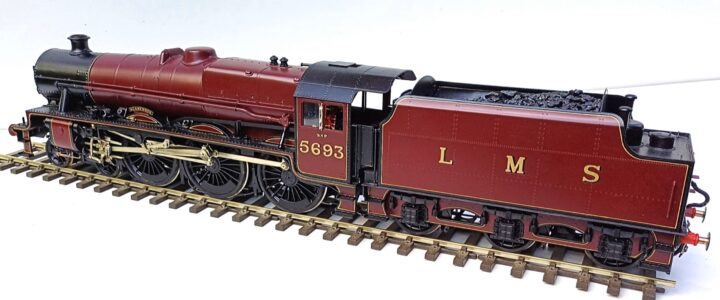
LMS Stanier Jubilee class 4-6-0 no. 5693 Agamemnon.

LMS Stanier Jubilee class 4-6-0 no. 5693 Agamemnon.
LMS Stanier Jubilee class 4-6-0 no. 5693 Agamemnon.LMS Stanier Jubilee class 4-6-0 no. 5693 Agamemnon. A DJH factory built and painted model, complete with certificate and original box. In my opinion DJH produce models to a superb build quality, but the final finishing is sometimes less so. The colour of this model is very good (not always the case with DJH). Since buying this Jubilee I have made one or two tweeks and adjustments to bring it up to my standard.

LMS Fowler experimental high pressure 4-6-0 no. 6399 Fury.

LMS Fowler experimental high pressure 4-6-0 no. 6399 Fury. This superb model was built from scratch with working inside motion by Bill Davis using AGH (Alan Harris) cast wheels, turned by Steve Ross and powered by an ABC Maxon motor/3 stage gear unit. Power collection is via the American method. The boiler and firebox was commissioned and produced as a one piece resin casting by Richard de Camin. The stunning paintwork is by Ian Rathbone and the model is featured on his excellent website https://www.ianrathbonemodelpainting.co.uk/gallery-1—7mm-scale.php and in the Gauge O Guild Gazette of May 2017.

The loco was built by the North British Locomotive Company at their Hyde Park Works in Glasgow in 1929. Basically a Royal Scot class with extended frames, two outside low pressure cylinders and an inside high pressure cylinder, operating on the Compound Principle. The double pressure boiler, designed to operate at 900psi and 250psi was built by the Superheater Company Ltd. The experiment was not a success. In 1930 a representative of the Superheater Company died from his injuries after being scalded on the footplate at Carstairs, when a high pressure tube burst. After repair the loco was trialled in 1934 between Derby and Wellingborough, with very little success. It was eventually rebuilt in 1935 by Mr. Stanier to become the final member of the Royal Scot class no. 6170 British Legion.
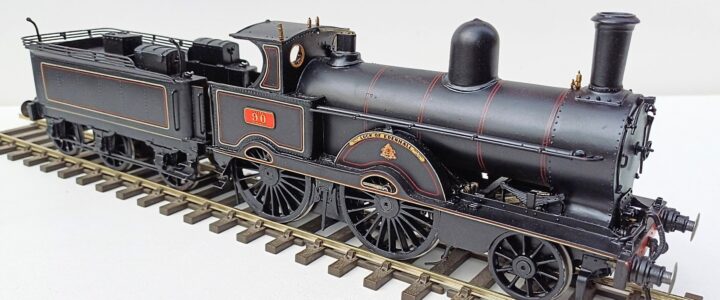
LNWR Webb Waterloo or Whitworth class 2-4-0 no. 90 Luck of Edenhall

LNWR Webb Waterloo or Whitworth class 2-4-0 no. 90 Luck of Edenhall

LNWR Webb Waterloo or Whitworth class 2-4-0 no. 90 Luck of Edenhall. This class of loco were essentially renewals of the earlier Ramsbottom Samson class. The model has been superbly built by Ray Wilkinson, I believe using the Mercian kit as a basis, but with a wealth of additional detail, including fully working Joy valve gear and inside motion. Also the cab backhead detail is well worthy of note. Beautifully painted by Ian Rathbone it is featured on his superb website.https://www.ianrathbonemodelpainting.co.uk/gallery-1—7mm-scale.php

This must be the only railway locomotive named after an item of glassware? The enamelled glass beaker “Luck of Edenhall” was made in Syria or Egypt in the middle of the 14th century? It is now in the Victoria and Albert Museum.

BR (exLMS) Stanier Princess Coronation Pacific no. 46241 City of Edinburgh

BR (exLMS) Stanier Princess Coronation Pacific no. 46241 City of Edinburgh.Well built by Ray Wilkinson and painted by Ian Rathbone, from the very good value David Andrews kit. With the correct Stanier style wheels by Slaters, an ABC motor and gear unit with power collection by plunger pickups, she performs very smoothly and powerfully. The leading axle is cranked to drive the working motion for the inside cylinders. This is a true “Semi”, more accurately a de-streamliner, with a sloping top to the smokebox and the tender rear correctly has the side extensions, twin tank fillers and a coal pusher. The attractive livery is the experimental “British Railways” blue with LNWR style red, cream and grey lining. Totally authentic for the period circa 1948-1951.