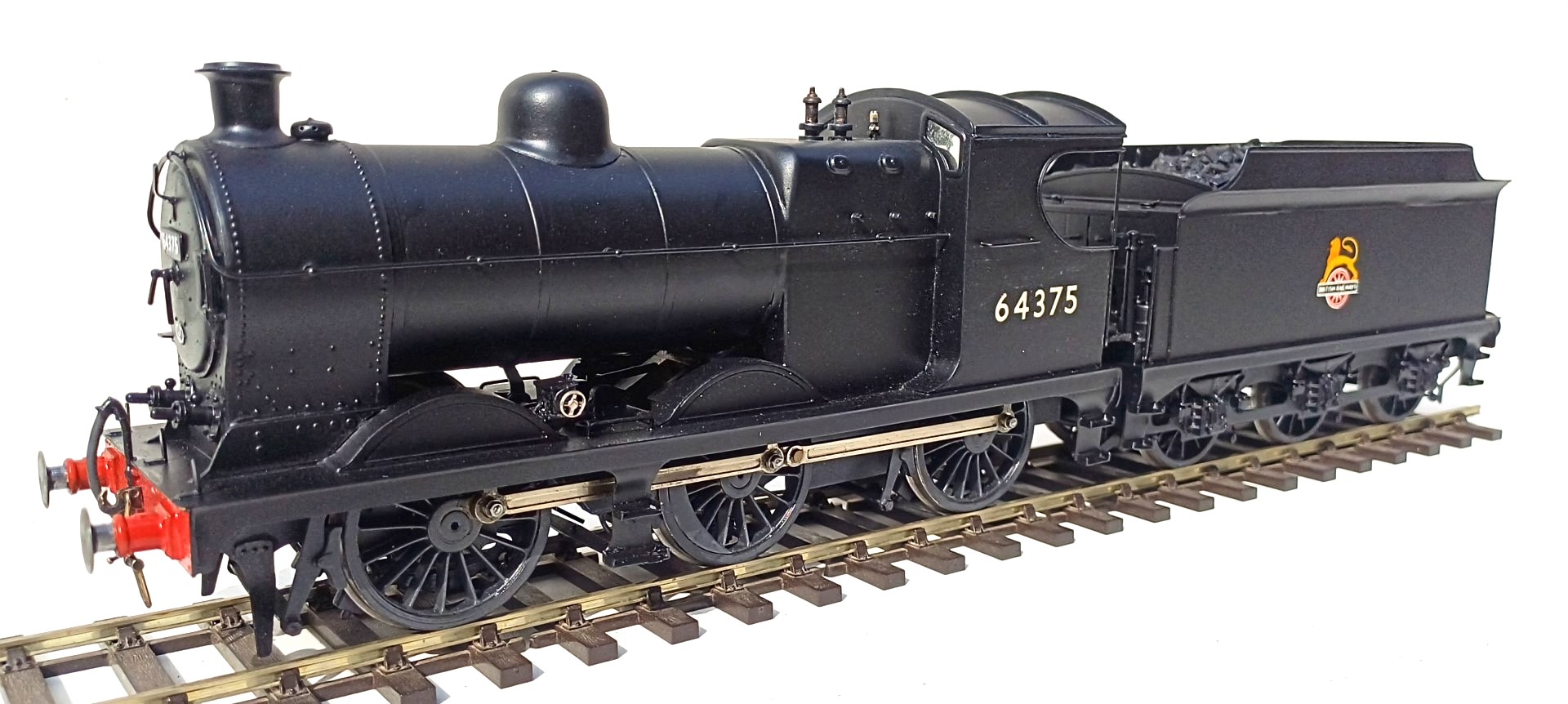
BR (ex LNER) Thompson rebuilt J11/3 class 0-6-0 no. 64375

BR (ex LNER) Thompson rebuilt J11/3 class 0-6-0 no. 64375
BR (ER) Thompson rebuilt J11/3 class 0-6-0 no. 64375. Bought from a recent auction. A client had asked me to build him a Pom-pom. This looked to be a good model, and it certainly has prooved to be. I tried to save him some money by buying this with the intention of stripping the paint, improving it where necessary, and having it repainted to his liking. That plan backfired on me, due to my lack of knowledge of Pom-pom’s. He wanted a model circa 1920’s. The J11/3’s were rebuilt by Edward Thompson from the mid 1940’s, with piston valves and the boiler raised by 4″ to accommodate them. So no good for my client. Never mind, I have still stripped the original hand applied paint and repainted it myself to my own liking. I am very pleased. Built from the Gladiator kit. It runs very well indeed, on Slaters wheels with power collection by plunger pickups.

LNER Gresley A3 class 4-6-2 no. 2750 Papyrus.

LNER Gresley A3 class 4-6-2 no. 2750 Papyrus. A Loveless model, obtained recently as part of a swap deal. DCC control with sound. Since purchased the sound has been upgraded to a Zimo MS 950 decoder by Richard Pogson, a vast improvement. The model is in the condition that the real loco ran to 108 m.p.h. Indisputably the first British locomotive to run at more than 100 m.p.h. Regular viewers of these pages might realise that the Gresley A3 class is up there as one of my favourite locomotive classes, whether in LNER green, BR blue, BR green, single chimney, double chimney, smoke deflectors, they always look good to me.
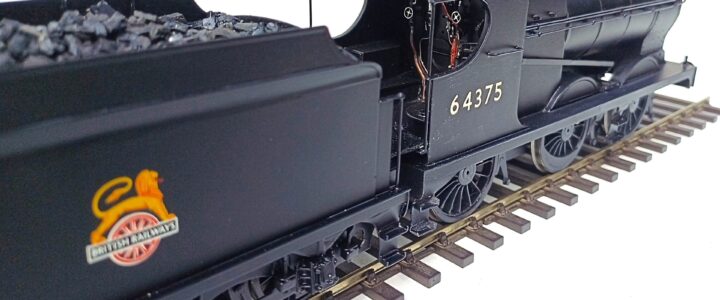
BR (ex LMS) Stanier Princess Coronation class 4-6-2 no. 46232 Duchess of Montrose

BR (exLMS) Stanier Princess Coronation class 4-6-2 no. 46232 Duchess of Montrose. This superb model is by Finescalebrass and as all other imported models that I have been in contact with, it runs very smoothly indeed. Surely painted and lightly weathered by Warren Haywood. I can say from experience that this is not up to the quality of a Masterpiece Duchess. But for value for money, it is well and truly right up there with the fabulous City of Nottingham that I once owned.

Duchess of Montrose will always be a special name for me. I’m sure I am not alone, it was my first Hornby Dublo loco. That company must have sold millions of them.

GWR Collett King class 4-6-0 no. 6019 King Henry V

GWR Collett King class 4-6-0 no. 6019 King Henry V. Professionally built from the superb Malcolm Mitchell kit, with working motion to the inside cylinders, Slaters wheels and a Portescap RG7 motor and gears unit. Current collection is by the American system, where the loco collects from one side of the track and the tender from the other. The drawbar and fallplate are both insulated to prevent short circuits. Well painted and fully lined out in GWR bronze green with “Great Western” in full on the tender and the twin shields emblem of the company between the two words. A recent buy from auction. Not quite in the basket case category, but considerable remedial work has been required to get this model into the lovely condition that you can see here. He now also runs very smoothly and quietly and looks pretty good too.

BR (ex LMS) Royal Scot class 4-6-0 no. 46148 The Manchester Regiment

BR (exLMS) Royal Scot class 4-6-0 no. 46148 The Manchester Regiment. Extremely well built and detailed, from the David Andrews kit by John Taylor of Halifax. AGH (Alan Harris) cast wheels and an ABC motor and gear unit. A very impressive model which I recently found in auction and have been lucky enough to acquire for my collection. When purchased, this model was portrayed as 46156, but at that time I already had a model of rebuilt 46156 and as the paintwork was not up to the quality of the build, I stripped it for a repaint and a new identity and you see the result here, courtesy of Warren Haywood. I must say that this repaint has transformed this well built model to a particularly attractive loco.

BR (ex LMS) Stanier Jubilee class 4-6-0 no. 45705 Seahorse

BR (ex LMS) Stanier Jubilee class 4-6-0 no. 45705 Seahorse
BR (ex LMS) Stanier Jubilee class 4-6-0 no. 45705 Seahorse.Well built from the Gladiator kit, powered by a Portescap RG7 motor and gear unit, with Slaters wheels and current collection by plunger pickups on each of the six driving wheels. Beautifully painted, lined out and weathered by Warren Haywood. The inspiration for me to buy an existing model, strip the paint, carry out any necessary repairs or improvements, before asking Warren to repaint it, came from a trainspotting trip to Manchester with my schoolmate Mark Hulme. At Patricroft shed, we were pleasantly surprised (these were the days when most remaining Jubilees were stored wrecks) to come across Seahorse, with yellow stripe, nameplates and fairly clean. Well worth a few quick snaps with my Kodak Instamatic. I now find that the loco was a celebrity, used regularly on the Buxton services, hence the replacement (probably wooden) nameplates and clean condition. WOW, is an expletive commonly used these days as part of the description for a very average Ebay item. In 1965, we were well and truly wowed by this loco.

LNER (ex GNR) Ivatt class D3 4-4-0 no. 4302

LNER (ex GNR) Ivatt class D3 4-4-0 no. 4302
LNER (ex GNR) Ivatt D3 class 4-4-0 no. 4302. This model has been well built in nickel silver from scratch. I bought this some months ago, on line from Footplate trains in an unfinished and unpainted condition. Originally built with a noisy motor, I have now fitted an ABC motor and gears unit. Good cab detail from scratch, cast iron wheels and a very clever hand made wiper pick-up unit, she is a very smooth performer indeed. Painted by John Cockcroft, doesn’t she look good ? A rare prototype to see modelled as no quality kits are available of a loco of this type.

GWR Armstrong class 4-4-0 no. 8 Gooch as running between 1903 to 1905

GWR Armstrong class 4-4-0 no. 8 Gooch as running between 1903 to 1905
GWR Armstrong class 4-4-0 no. 8 Gooch as running between 1903 to 1905. This model was what I call a “basket case”. One of the superb Modern Outline Kits. There could be many of these kits around, where the original buyer/builder has bitten off more than he can chew, realising the complexity of this kit is beyond his skills. Probably placed in a wardrobe waiting for him to build his confidence to give it another go.
It has now been completed by myself to a smooth running condition, and painted by Warren Haywood. Slightly different to other MOK Armstrong class models on these pages. Notice fenders on the tender sides, not coal rails. Lamp irons, not lamp sockets. Different clack valves. All features as seen on archive photos of the prototype. Driven by a Portescap RG7 motor/gear unit. Unfortunately the crankshaft and connecting rods were missing/lost before I acquired the model, so, although it does have slide bars and crossheads, there is nothing there to drive them.
The descriptive notes above explain why I can afford to offer this lovely model for sale at roughly half the price that I have sold similar models to this of top quality. It is not a perfectly built model. Don’t expect it to negotiate tight curves or to pull heavy loads, but it has been built square and true and is very good value for money for one of these magnificent MOK Armstrong class models.


GWR Churchward Saint class 4-6-0 no. 2923 Saint George

GWR Churchward Saint class 4-6-0 no. 2923 Saint George
GWR Churchward Saint class 4-6-0 no. 2923 Saint George. This is a special model for me. In 2008, at Mellors & Kirk auctioneers in Nottingham, it was sold with provenance, as part of the Simpson collection of 31 finescale model locomotives. All scratchbuilt, mostly by Peter Everton or Brian Broumpton and painted by Alan Brackenborough. Three of them had been built by Stanley Beeson. I attended the auction, with little available cash, and was very disappointed to come away with nothing. Advance in time now to January 2024 and this model (with another, a King 6024 by Mr. Everton) is again in the same auction house, but this time in a damaged condition. Nameplates missing, two scratches to the green paintwork and a damaged (and very crudely glued back together) cab. The buyer in 2008 has clearly not looked after his purchases (the King was also in a play worn condition) and has probably now passed away. After careful viewing, I decided that if it could be obtained at the right price, restoration could be achieved, and here is the result. Mechanically it did still run quite well. Parts of the tender brake gear were missing and have had to be replaced. The cab has been completely broken down to it’s individual parts, thoroughly cleaned of all glue deposits and rebuilt as a soldered together unit. Fortunately, Mr Broompton built this model with the cab screwed to the running plate and fitting around the firebox and backhead (just like the real thing and unlike kit built models these days), making the repair of the cab considerably easier and also the painting and lining of the cab spectacle plate considerably easier also. John Cockcroft has made a superb job of repainting the cab and restoring the rest of the paintwork to match Mr. Brackenborough’s original finish. New plates by Severnmill complete the rebuild of this fine model. I now get to own and enjoy one of the models that I disappointingly missed out on 16 years previously. I may have missed out, but attendance to that auction in 2008, gave me the ambition to collect fine scratchbuilt models like this.