BR (ex GWR) Dean Goods 0-6-0 no. 2538. This model has been skillfully built from scratch, the loco in nickel silver and the tender in brass. It would seem that the unknown builder sadly passed away before he could finish it, as I found and bought it out of the Gauge O Guild Executors in unpainted condition. A little TLC and a good clean, a coat of primer then black paint by myself together with a real wooden floor by Poppy’s to give a lovely realistic cab detail. She has made into a good looking and reliable loco, with weathering by Richard Pogson. I have modeled her as the last member of the class to be withdrawn, in 1957 from Oswestry shed. She outlived her now preserved sister no. 2516 by a year, becoming something of a celebrity and being kept in reasonably clean condition for hauling special trains. The two locos had been retained principally for working the Abermule – Kerry branch line. This model is for sale, if interested please visit the models for sale section of this website.
Barry Railway “K” class 0-6-2T no. 119. Built from scratch by Ray Butcher, who usually used Alan Brackenborough to paint his models and I see no reason to doubt this model is not Alan’s work. It is an extremely well built and painted model of a very unusual prototype. Slaters wheels, compensated suspension and a very neat ABC mini gear and motor unit. The class of five were assembled in 1899 from a kit of parts that had been designed by Mr.Hosgood and delivered to Barry Docks from America, giving them the nickname “Yankees”. Above the running plate they were typical Barry style, but American bar frames and Richardson balanced slide valves gave them a very powerful appearance. They were Swindonised in 1924, becoming GWR numbers 193-197.
LNER Gresley K3 class no.1816. Built from scratch by D. Miller and expertly painted by the late Robin Bell. Signed on the underside of the running plate “Built D. Miller 5/93” and “Painted R. Bell 5/93” giving provenance. The wheels are of the Slaters type and the motor and gears are of the MSC JH type. The bogie and drawbar are both sprung to the centre to guide the model around curves.
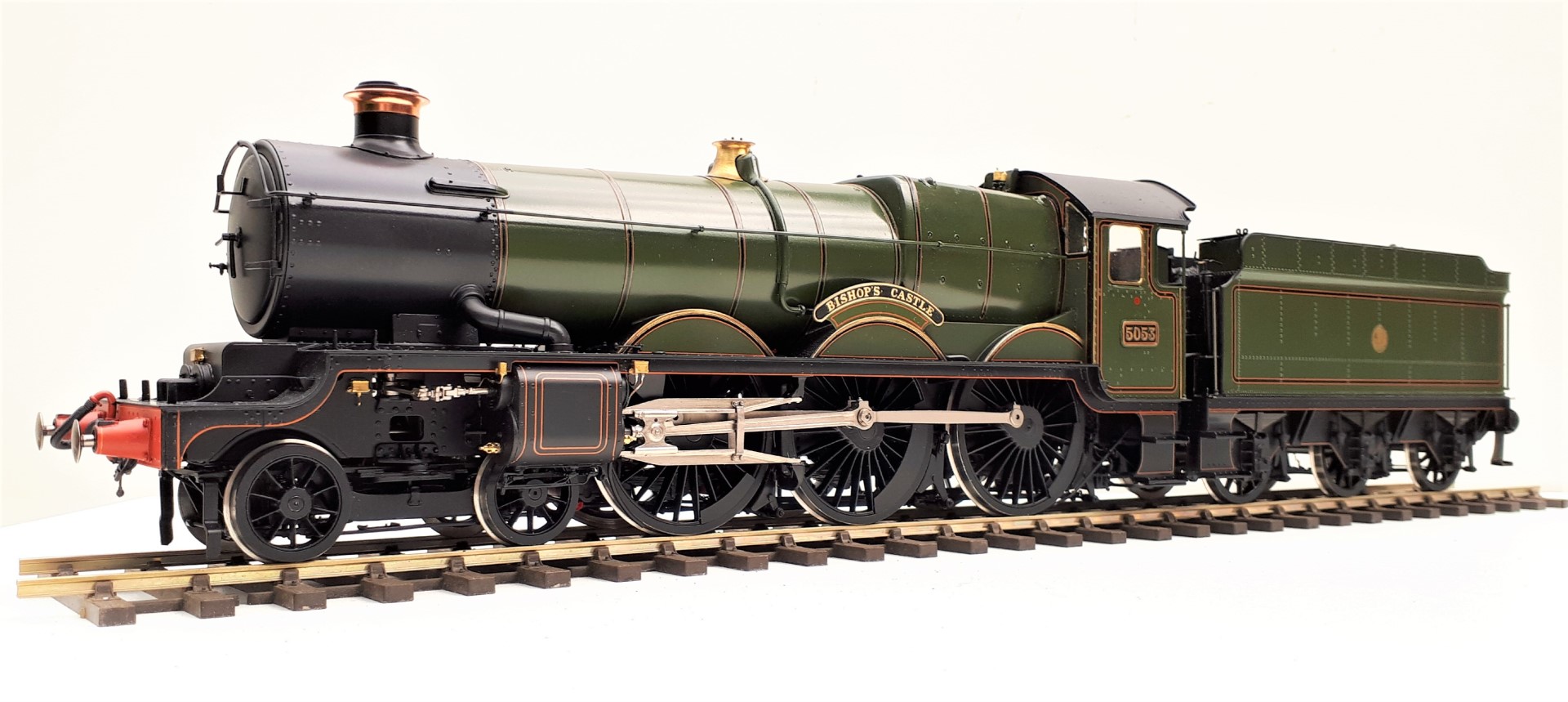
GWR Castle class 4-6-0 no. 5053 Bishop’s Castle. A Masterpiece Model, bought from auction, lacking it’s original nameplates. As the full size 5053 carried two names in this livery, firstly as built Bishop’s Castle, renamed Earl Cairns after 15 months of service, I could make the choice. The former was chosen as I have a lovely photo of it with that name. The model has DCC control, performance and sound both in perfect working order.
Southern Railway N15 class 4-6-0 no. E736 Excalibur. This model has been expertly built from scratch in brass by a person unknown. It has a Leakey motor and gears and uses the American method of power collection. Purchased from a Vectis auction in an unfinished and unpainted (tender primed) condition. After building, the model had been left to gather dust for many years. I have now stripped the tender of primer, replaced a Maunsell type chimney with this Urie type, coarse scale handrail knobs and handrail, rebuilt the cab and tender floors and generally completely overhauled the body and the motion to give a sound and powerful working model. Now painted in Robert Uries London & South Western Railway olive green by John Cockcroft. In my opinion he has the shade of green spot on. I asked him to match the colour of the jacket of D.L.Bradley’s book “LSWR Locomotives The Urie Classes” and he has done exactly what I asked.
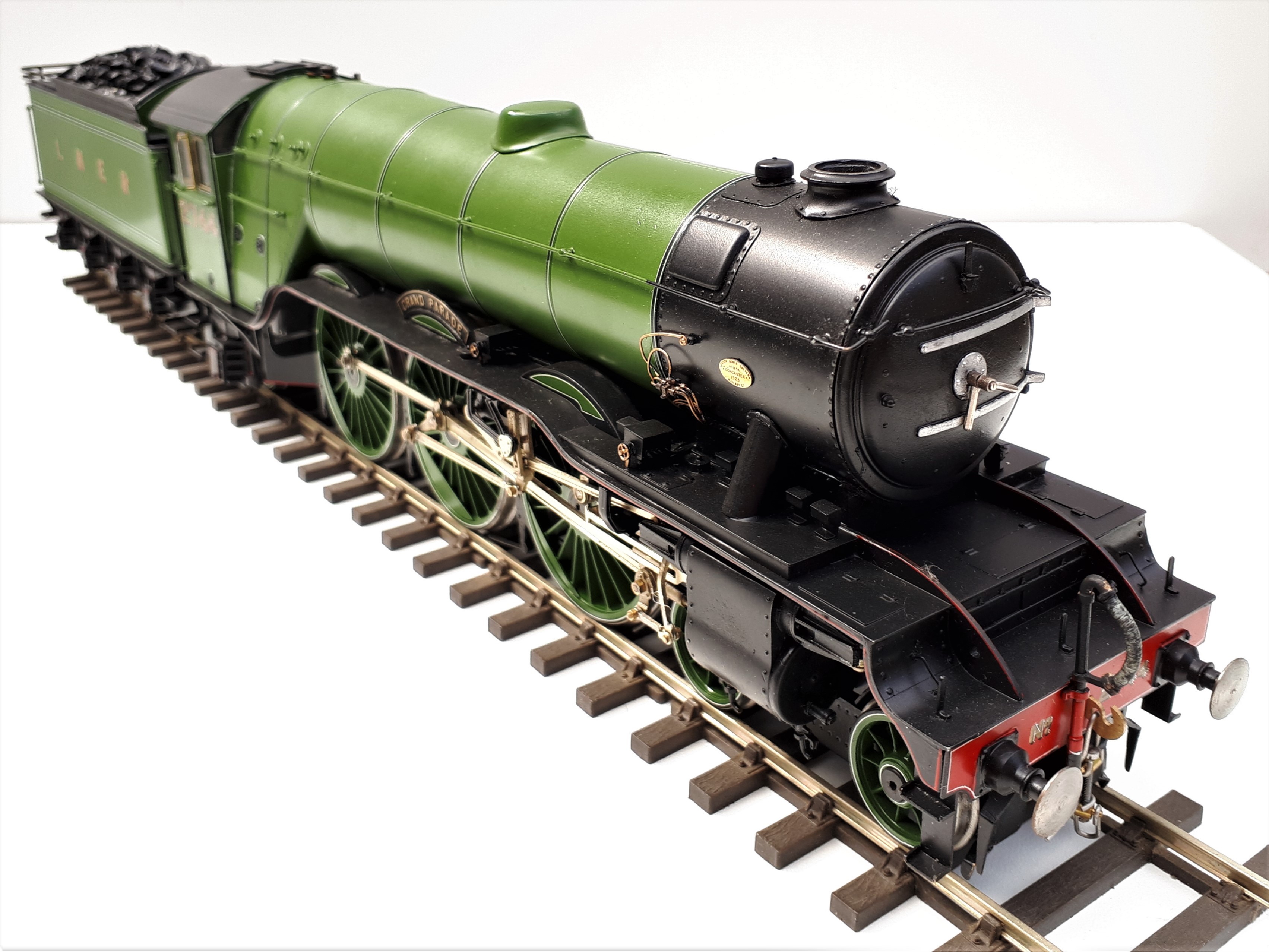
LNER Gresley A3 class no. 2744 Grand Parade. I have recently acquired this lovely model from auction. It has been built and painted to a professional standard from the DJH kit. Judging from certain details, it could have been produced by one of the DJH factory team of builders themselves, although no certificates came with it as provenance. I am normally not a fan of DJH factory built LNER green models as I think their usual colour is too bright, https://www.djhmodelloco.co.uk/prodpage.asp?productid=3423 but this model is an exception as the colour is to my eyes very good for Doncaster green. Perhaps one built before they changed to the brighter green? Or perhaps produced by another very capable builder and painter? Powered by a motor with a delrin drive gearbox via plunger pickups. A modification to the bogie springing is all I have needed to make to enable it to travel around the Poachers test track without de-railing. This kit has been around a number of years now and I have built two others, Salmon Trout in LNER green and The White Knight in BR green. The kit is excellent and builds into a very proto-typical looking model. Fairly easy to build as well. You just need to shake the box of bits and they all fall into place. Just a shame that whoever the painter was, he originally made it no. 4480 Enterprise (very likely an example of the tail wagging the dog, or in this case the client wagging the painter). That loco was never a left hand drive loco whilst in LNER days. Carefully we have changed the cabside and buffer beam numbers to 2744 and the nameplates to Grand Parade, the name and number of one of the locos built at Doncaster in 1928 as left hand drive. As Peter Coster writes in Irwell Press’s fabulous “The Book of the A3 Pacifics” there were of course two Grand Parades, the first was destroyed in the Castlecary accident in 1937. This model depicts the second one, built in 1938 to replace the wrecked original loco. Mr. Coster writes that they “differ only in the boiler number and tender number” failing to spot that the second Grand Parade had steps behind the front buffer beam and the first did not.
LNER (ex NER) Y7 class 0-4-0T no. 982. Scratch built by Ron C. Pearsall Models, a diamond makers plate on the underside “RCPM”. Expertly painted by Larry Goddard and signed on the underside “Paintwork L.W.Goddard ’82” all giving provenance. Until I acquired this model it had not turned a wheel in 37 years since painting. Just needing a little light oil on the bearings and worm drive, TLC and a minor adjustment and it is as good as new again. It has been built using the split axle system, power collection to the motor being through un-insulated wheels and the main frames. A system rarely used since the introduction of Slaters type insulated wheels. It runs superbly.
LB&SCR Stroudley B1 class 0-4-2 no. 179. This model was bought off of Ebay, superbly part built, from scratch in brass. I do not buy many models from auction unless I can handle them and see them with my own eyes. But the build quality of this looked so good that I could not resist it. The tender was pretty well complete, as was the chassis and cab. All wheels (Slaters) were supplied and the boiler was supplied as a cut-out flat sheet. All I had to do was fit an ABC motor and gear unit, roll the boiler, make it fit (which wasn’t easy) and then make it all work. Doesn’t sound much, does it? But I can tell you it gave me some headaches. Warren Haywood has expertly added the paint for me. She runs like a dream, so all’s well with Ebay and well worth the risk.
The model is of course of one of the famous and very successful “Gladstone” class express passenger locomotives, designed by William Stroudley. When running in it’s original livery no. 179 was named “Sandown”, but after Stroudleys’ death, his successor Earl Marsh had it repainted in his own very attractive umber livery, without the painted name. It also carries Marsh’s design of smokebox door, continuous handrail over the smokebox and tender fenders. Otherwise she is in as built condition, including the very attractive brass cab side number plates, as running circa 1906.
Midland Railway class 4 Compound 4-4-0 no. 1009. Bought part built, basically from the well known and excellent Slaters kit, but with many additional features, for example the early type Deeley tender with straight edges to the base of the tank. Rarely modelled, but historically correct for the prototype. Only ten of these tenders were built and originally fitted to numbers 1005 to 1014. Now finished by myself and in full working order with wiper pick-ups and side springing to the bogie. The model is fitted with the excellent Ron Chaplin Gold gears and motor unit and has been superbly painted and lined with bow-pen by John Cockcroft.
BR(MR) Princess Coronation class Pacific no. 46245 City of London. Very well built from the Gladiator kit with Slaters wheels and a very smooth, quiet and powerful Crailcrest motor and gear unit. This model was bought from auction in a painted condition that, lets say, was not very sympathetic to such a well loved class of locomotive. It had originally been built to a professional quality and painted in British Railways crimson lake livery as no. 46245 City of London, complete with cabside yellow stripe. A condition that I well remember seeing the full size loco at Derby works open day in 1964. The model must have looked truly wonderful and would have been the envy of most O gauge modellers……….. until someone saw fit to overspray it in silver paint. Apparently for a film set. Fortunately and the one saving grace, they masked off the chassis, cylinders, wheels and motion of the loco. Over the past few months I have stripped off all of the paint from the main body of the loco and tender. I have ensured that the model is now in fully working condition and repaired any areas and added extra detail that the model needed to bring it up to my own personal exacting standards. John Cockcroft has made a wonderful job of repainting (less yellow stripe) and she is now in better than original condition. As a passionate collector of fine scale models I am very proud to be responsible for buying and restoring to it’s former glory this fine model.