GWR William Dean 517 class 0-4-2T no. 548

GWR William Dean 517 class 0-4-2T no. 548
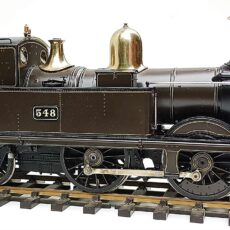
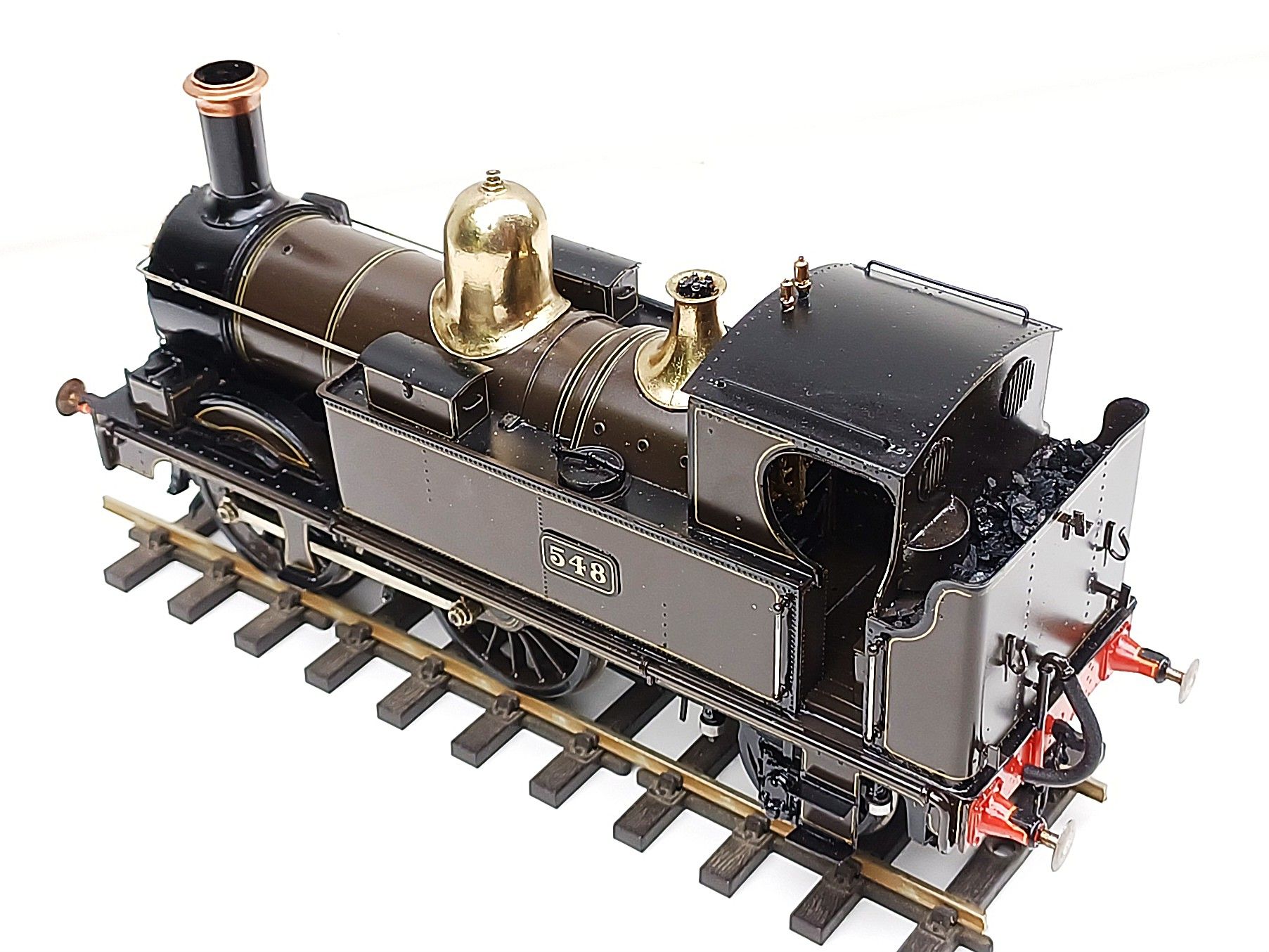
GWR William Dean 517 class 0-4-2T no. 548. This lovely little model has been very well built from the superb Malcolm Mitchell kit with Slaters wheels, an MSC JH motor and gear unit and a representation of inside valve gear and slidebars. Power collection is by plunger pick-ups to driving wheels, tested hauling a “B” set at the Poachers running session last Sunday, she runs very smoothly indeed. When bought, the model was quite good, but carried only a fair rendition of the GWR plain green livery. Now stripped of its original paint and repainted by Warren Haywood in the superb GWR chocolate livery, Warren has improved this little chap to another level. After WWI, some enclosed cab 517’s were painted in this lovely brown livery (they were nicknamed “chocolate soldiers”) to match the livery of autotrailers. Some of the brown 517s are thought to have retained the livery until the mid-1920s.

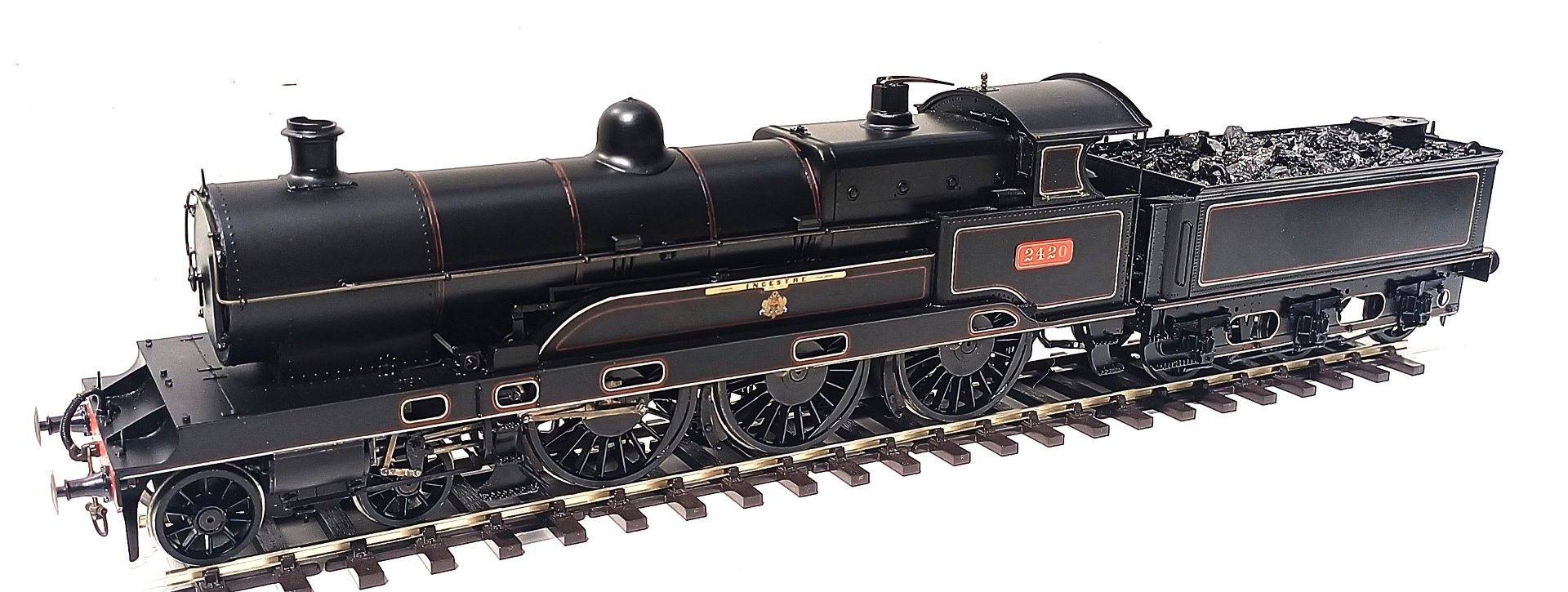
LNWR Bowen Cooke George V class 4-4-0 no. 1360 Fire Queen

LNWR Bowen Cooke George V class 4-4-0 no. 1360 Fire Queen

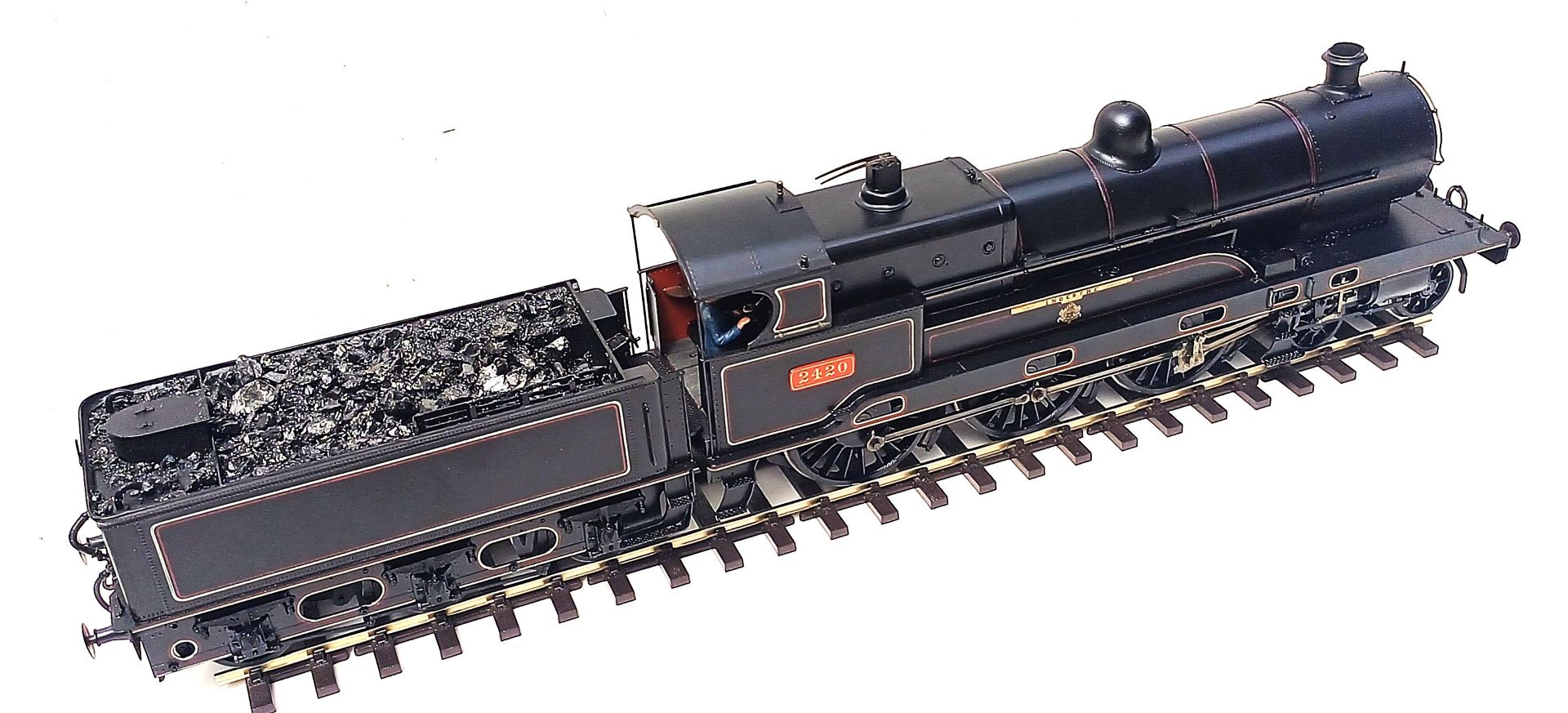
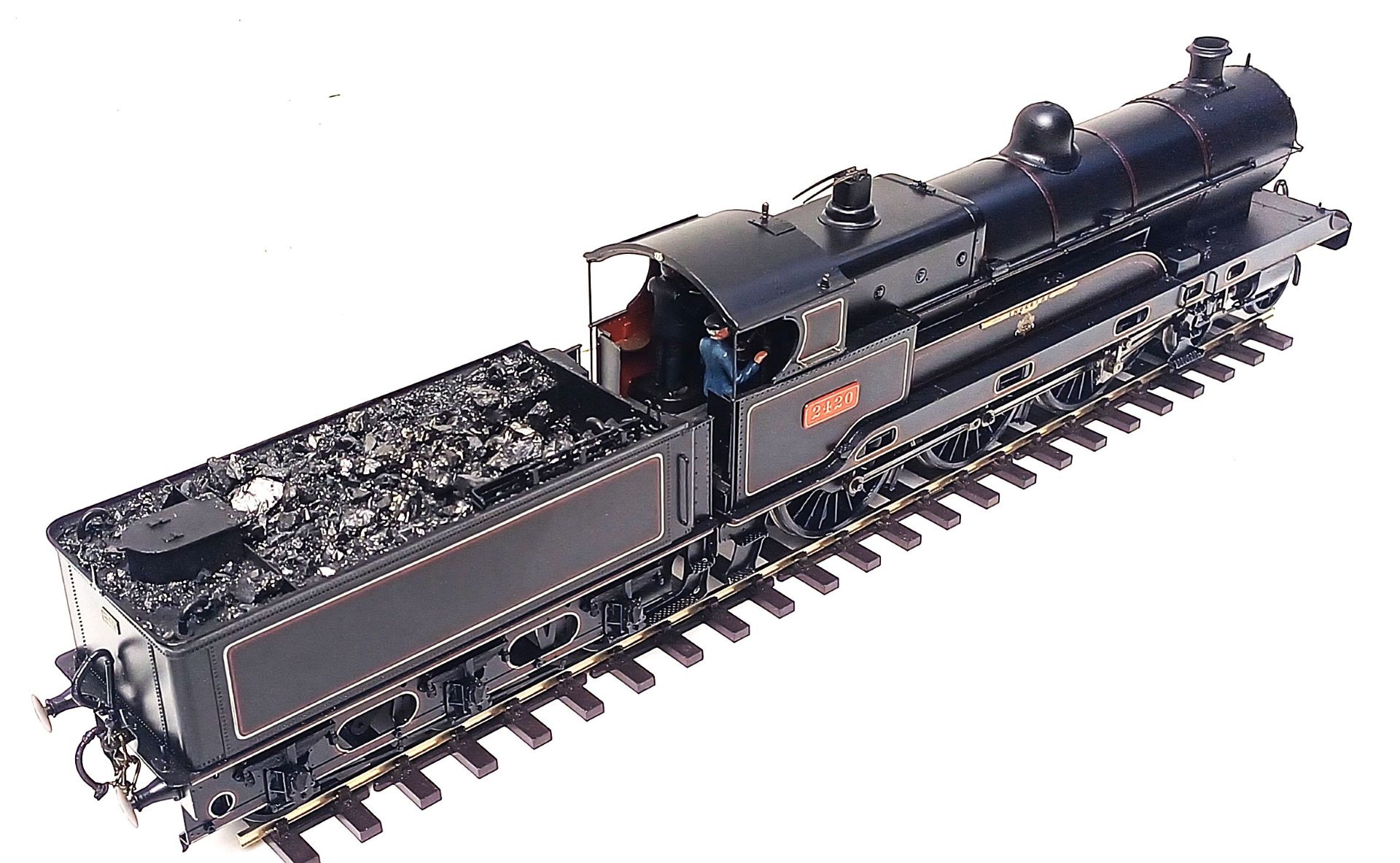
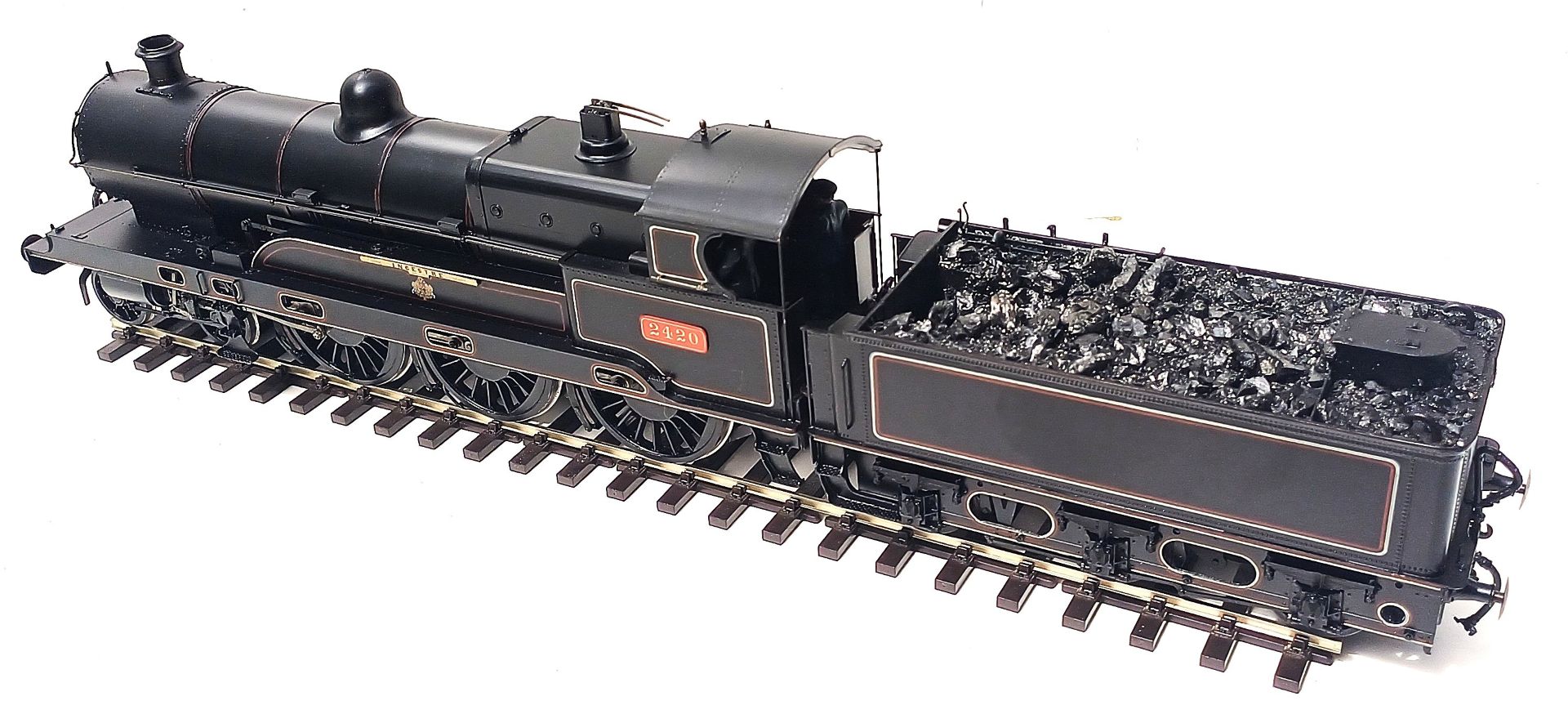
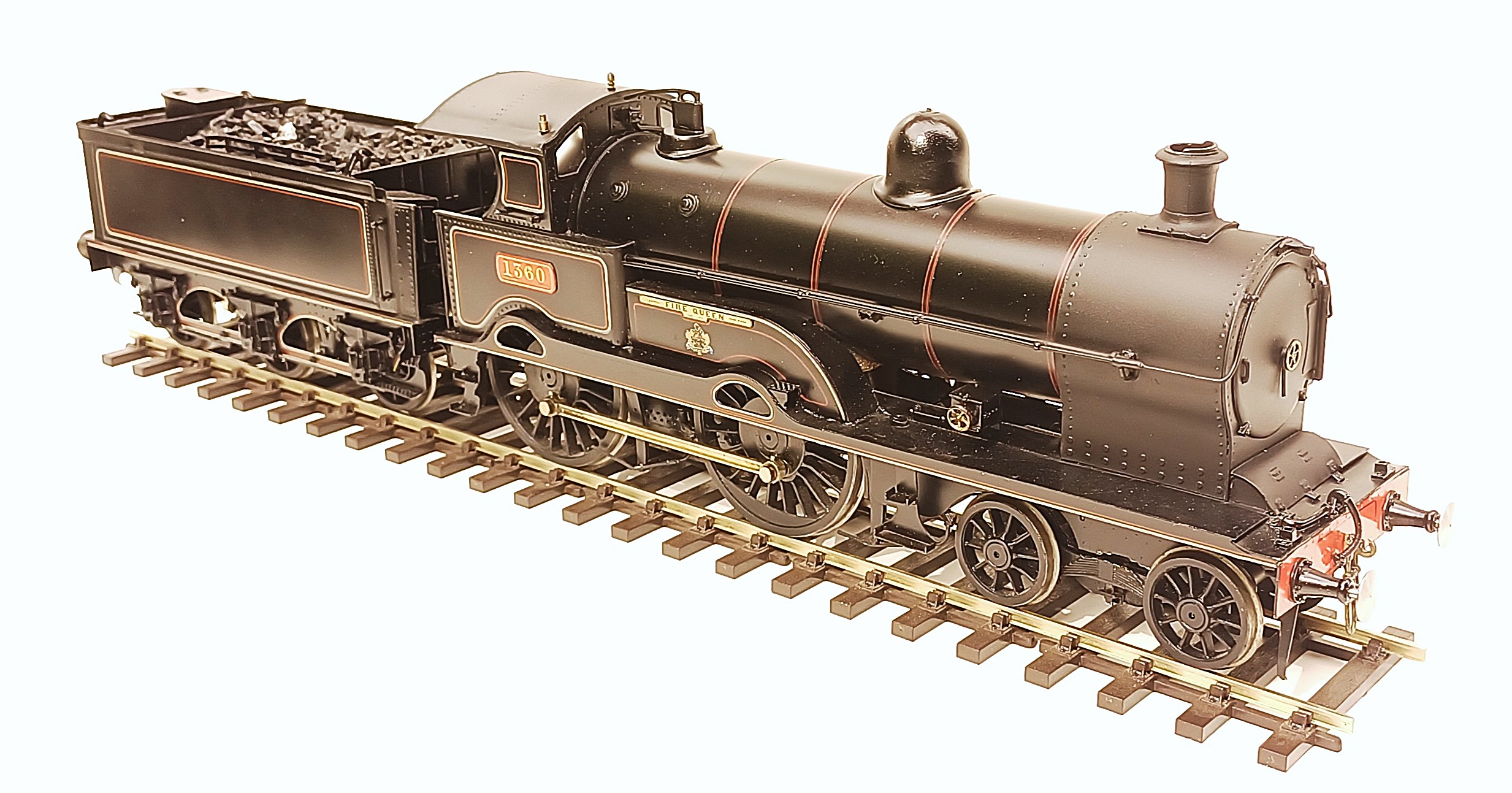
A well built model from the David Andrews kit, with an MSC JH type motor and gear unit powered by plunger pickups and Slaters wheels, it runs as smoothly and powerfully as it did the day that I bought it from Rich at Footplate in Nantwich. However at that time number 5000 Coronation had been in the wars somewhat, losing one of its nameplates and taking with it a good size lump of paint. Now, after disassembly, paint stripping, the addition of lamp sockets, new handrails, and name and number plates giving a new identity. A superb new coat of blackberry black with hand/bowpen lining by Warren Haywood, doesn’t she just look the part? He’s done a lovely job with the differing textures of paint finish between smokebox and boiler. Just like the shiny LNWR locos that we can still see in pre-grouping period photos.

BR (ex GNR) Gresley class K2/1 2-6-0 no. 61742

BR (ex GNR) Gresley class K2/1 2-6-0 no. 61742
BR (ex GNR) Gresley class K2/1 2-6-0 no. 61742. This lovely model has been expertly built from scratch by Harold Humphries. In my early days of gauge O model building, a good friend of mine by the name of Graham Jaques used to tell me about “Harold”, an elderly gentleman who Graham looked upon as being his modelling mentor. Harold passed away and Graham, (who was a superb builder himself, good enough to win the Guildex Chairmans trophy with a scratchbuilt and painted GNR Atlantic) acquired this model. Now after Graham’s passing some years ago, I have acquired it and I must say that the old gent really could build a superb model loco. ABC gears, Slaters wheels and current collection by plunger pickups, this K2 runs very smoothly and powerfully.

BR (ex LNER) class K1/1 2-6-0 no. 61997 MacCailin Mor, Thompson rebuild of Gresley K4 class.

BR (ex LNER) class K1/1 2-6-0 no. 61997 MacCailin Mor, Thompson rebuild of Gresley K4 class. Edward Thompson’s rebuild of Nigel Gresley’s 3 cylinder K4 class no. 3445. Very nicely built by Jon Boot of the Denton Works, using the DMR kit as the basis of construction, but with many scratch details to portray accurately the rebuilt locomotive which was the prototype for the K1 class. With a Slaters GB30R-3M spur drive gearbox and motor unit and Slaters wheels he runs superbly. Very well painted indeed by John Cockcroft. In this condition a rare to see model of this unusual locomotive.

BR (MR) Ivatt Princess Coronation class Pacific no. 46257 City of Salford

BR (MR) Ivatt Princess Coronation class Pacific no. 46257 City of Salford
BR (MR) Ivatt Princess Coronation class Pacific no. 46257 City of Salford. Rare to see a model of this particular loco. In the past I have had in my collection models of Duchesses, but all built from kits, Martin Finney and David Andrews, or imported from Korea Sangcheng and Masterpiece. But I have never had one that has been built from scratch before, and 46257 is up there with any the others for value for money. Substantially built to last, many years ago, in nickel silver, by Graham (tinsnips) Powell, with good quality cast metal wheels with fine spokes without webs, and with telescopic axles. The front two with a small amount of compensation with each other, the third fixed and driven by a chunky gear and powerful motor unit, an MSC Crailcrest I believe. Power collection is by plunger pickups. Bought by myself from a recent on-line auction, as 46256 Sir William A Stanier FRS, with a nameplate missing, and damaged red paint. He has now been stripped of his coat, rebranded to the much rarer City of Salford, and superbly repainted in dark green with light weathering by Warren Haywood. I will concede that some of the detail of build of this model does not have the perfection of a Korean import, but doesn’t that add to it’s character? I am delighted with the result of this risky purchase and wish that I had the model building skills of Graham.

Highland Railway Jones Tank class 2-4-0T no. 59 Highlander

Highland Railway Jones Tank class 2-4-0T no. 59 Highlander
Highland Railway Jones Tank class 2-4-0T no. 59 Highlander. Spotted in a recent provincial auction in a filthy and playworn condition, it’s potential wasn’t lost though in my eyes. This rarely modelled locomotive, part of a class of three, was built in 1879 at the HR’s Lochgorm works. In this wheel arrangement they were used on the Aberfeldy and Burghead branches without too much success and in 1887 Highlander was rebuilt with a front bogie. In 1900 it’s name was removed, and in LMS days it was repainted into crimson lake livery and renumbered 15010. I have had in my collection a model of the same loco, in that condition. Unfortunately now sold, but an image of it is included here to show it in the lovely crimson lake. Originally built from a Shedmaster kit, with Slaters wheels, plunger pickup power collection and a single gear driven by a Mashima motor. Now cleaned and stripped of paint by myself, the once very rough running has been considerably improved by some intricate surgery inside the body. The chassis now lubricated and with clean pickups, now runs smoothly and quietly. The superb new paintwork in the even more lovely original Jones livery is by Warren Haywood.

L&NER (ex GCR) Robinson B2 (later B19) class 4-6-0 no. 423 Sir Sam Fay

L&NER (ex GCR) Robinson B2 (later B19) class 4-6-0 no. 423 Sir Sam Fay
L&NER (ex GCR) Robinson B2 (later B19) class 4-6-0 no. 423 Sir Sam Fay. Very well built from scratch, my preference, and not from a kit as it was described on Ebay. So a very pleasant surprise for me when I opened the box. Good quality cast iron wheels and the loco initially worked well with a single gear JH type motor and gear unit. However, in the forward direction only it ran out of puff after only a few minutes. (it seemed OK in reverse??). The motor did have a long flywheel spindle protruding from the back, so I thought it must be rubbing on the front face of the spectacle plate, but on investigation, no witness marks. Tried on the rolling road chassis only, still the same? So out came the gears and in with an RG7. Problem solved. He runs as good as he looks now.
Well painted in the 1923 L&NER green, Gortons version, which if the truth was told was no more than the works old stocks of GCR green with a gallon or two of white added to make it a bit brighter, (note the ampersand and also the GCR cabside numberplates).

BR (ex MS&LR) Parker N4 class 0-6-2T no. 69246

Found recently on Ebay, I recognized this model instantly as being built by my good friend and superb modeller, Nick Dunhill. I won the auction without competition. Nick built this model in 2003 using the North Star kit as a basis of construction. He doesn’t do anything by halves. Many additional details have been added, not to mention fully working inside Joy valve gear. The same year he entered it into the Gauge O Guilds “Guildex” modelling competition at Telford, where it swept the board, winning the big prize of the Chairmans Cup and the Marylerayne Cup which is for kit built models. The model is featured in the November 2003 issue of the GOG Gazette. Slaters wheels, driven by an ABC gear and motor unit on the third axle. The leading two axles are sprung with hornblocks and guides. Power collection is by wipers on top of all of the driving wheels.

Since purchase I have had to make a modification, however. Disappointingly after arrival I find that someone in this models dim and distant past had “improved” it by adding DCC control and sound. That worked well, but as no space was available in the boiler, that person had just placed the DCC decoder, speaker and stay alive with all associated wiring, in the cab space. Not an improvement for me, so I have removed it and the model works very well DC only now. A shame, I know, but I don’t mind my models having well painted crew in the cab, but not a ball of screwed up wires which almost filled the cab space. Also disappointingly the Ebay vendor managed to somehow take his photos without showing this “feature”. I left positive feedback as the model is just superb. I’m happy.