LNER Thompson L1 class 2-6-4T no. 9000

LNER Thompson L1 class 2-6-4T no. 9000
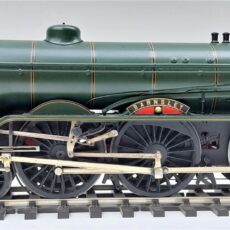
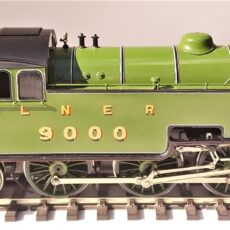
LNER Thompson L1 class 2-6-4T no. 9000. This lovely model has been very nicely built from scratch, with superb detail, by the same builder as the model of Flying Scotsman, recently published. If the amount of good quality detail is anything to go by, my guess is that this very accomplished model maker, probably now deceased, built 4472 early in his modelling career and 9000 later. Good paint finish, the green colour to my eyes is more of a Darlington shade of apple green. Cast iron finescale wheels, driven by a Portescap RG7 motor/gear unit and plunger pickups. The model is wired for DCC control and good sound and works well on my rolling road to the address of “9000”.
No. 9000 was built at Doncaster in 1945 as Mr. Thompson’s prototype 2-6-4T and was thoroughly tested throughout the LNER system before the rest of the class were built, with various detail differences, three years later. It became BR no. 67701.
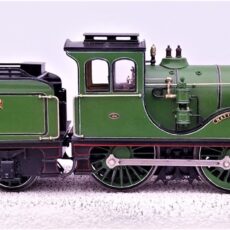
LNER (ex Great North of Scotland Railway) D40 class 4-4-0 no. 6850 Hatton Castle

LNER (ex Great North of Scotland Railway) D40 class 4-4-0 no. 6850 Hatton Castle
LNER (ex GNSR) D40 class 4-4-0 no. 6850 Hatton Castle. This lovely model has been built from scratch by Mr. R. A. Jamieson and carries his nameplate “RAJ Troon” as provenance on the underside of the running plate. Fitted with good quality cast iron wheels and a Portescap RG7 motor and gear unit. The driving wheel axles are compensated. The tender wheel axles are free to ride in hornblocks and guides. The bogie wheels collect the current and the bogie carries springs to control side swing and vertical downward pressure. The tender drawbar is spring loaded. All giving a very impressive smooth ride and haulage capacity. An excellent representation of inside motion and superb interior cab detail completes this top quality model. I bought this model on Monday 13th Feb., sold it the following Saturday. In only five days of ownership I replaced the smokebox door handles and polished the high quality replacements, removed black paint from the door hinges and polished them. Removed silver paint from all loco and tender handrails and polished them to bright metal. Removed gold paint from safety valves and weathered them. Removed gold paint from whistles and polished them…….. A pet hate of mine, if parts of the model are nickel silver or brass and need to be finished nickel silver or brass, why paint them with metallic looking paint? With just a few hours work I think I improved this model considerably and the quick sale proves my point.

It has come to my attention that Mr. (Bob) Jamieson built two models of a D40, probably at the same time (1990). The other one, no. 6845 George Davidson, was painted in the same livery by Alan Brackenborough, and is featured on page 48 of the Gauge O Guild Gazette of May 2016.
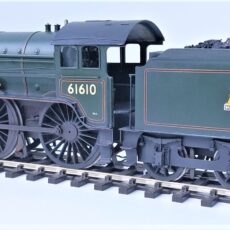
BR (ex LNER) Gresley B17 class 4-6-0 no. 61610 Honingham Hall

BR (ex LNER) Gresley B17 class 4-6-0 no. 61610 Honingham Hall

BR (ex LNER) Gresley B17 class 4-6-0 no. 61610 Honingham Hall. This model was built many years ago, from scratch in brass, with cast iron wheels, large worm drive gears and American style current collection. Finished to a good standard of detail, but only painted in basic plain black as NE no. 1647 (both nameplates had come adrift and been lost). I acquired it from auction and have added more detail, like cylinder blow-down pipework and cylinder lubricators. The number 1647 was not accurate as that loco did not have a Westinghouse pump alongside the smokebox, so it has now been repainted and weathered by John Cockcroft. It is now also blessed with nameplates as this fine model deserves. This model is for sale, if interested see the models for sale page of this website. 

BR (ex GNR) Gresley A3 class 4-6-2 no. 60102 Sir Frederick Banbury

BR (ex GNR) Gresley A3 class 4-6-2 no. 60102 Sir Frederick Banbury

BR (ex GNR) Gresley A3 class 4-6-2 no. 60102 Sir Frederick Banbury. The loco chassis of this model was built by the late Wally West, using top quality cast metal wheels by Allan Harris (AGH). Wally part-built three Gresley Pacifics at the same time. Great Northern and Robert the Devil have been completed for some time and appear elsewhere on the pages of this website. The loco body that this chassis was intended for (we believe it was to be an A4) was never completed. The skeleton of an A4 streamlined casing was found after Wally’s passing and putting two and two together that skeleton and this chassis was as far as Wally got with his A4. I was asked by the West family to sell any unfinished models, but the quality of workmanship is so good on this chassis, I couldn’t resist buying it for myself. By coincidence, I already had a Martin Finney part built A3 kit, which was in a right old mess, especially the chassis. The body and tender were recoverable however and I have married the three units together and this is the result. Fabulous paintwork by Warren Haywood. Gear and motor unit by ABC.

The full size loco was built by the Great Northern Railway in 1922 as their second Pacific and soon after it was named after the Chairman of the company. Modelled in BR days, it was a long time GC line loco, being allocated to Leicester GC, Neasden, after modification to right hand drive, Leicester GC again, then in 1957 it went to Kings Cross, Doncaster, Grantham, then KX again before withdrawal in 1961. A famous loco, it should have been preserved, as the only original GNR Pacific.

GWR William Dean 517 class 0-4-2T no. 1475

GWR William Dean 517 class 0-4-2T no. 1475. This lovely little model was built by Raymond Walley from the superb Malcolm Mitchell kit. It carries Raymond’s builders plate on the underside as provenance. Superbly built with compensation on the driven axle and a representation of inside valve gear and slidebars. It is powered by an ABC “Mini” motor and gears unit. Top quality cast iron wheels are by AGH (Alan Harris) and with power collection by wiper pick-ups she runs very smoothly indeed. The paint, as bought at the Gauge O Guild show in Guildford last November (2022), was signed by Dennis Morley. Sorry Dennis, but that didn’t cut it with me, so since purchase, I have stripped the original paint and Warren Haywood has made a superb job, as always, of the new paintwork. Now this little loco has the quality of paintwork that befits it’s quality of build and parts.

BR(ER) Gresley A3 class Pacific no. 60036 Colombo

BR(ER) Gresley A3 class Pacific no. 60036 Colombo. Very well built from the Martin Finney kit with an ABC motor/gear unit, Slaters wheels, plunger pick-ups on the loco with additional current collection from the tender. This is another of my recent auction buys. It was originally well painted in BR green as Night Hawk, but the style of tender was not historically accurate for a loco in that livery. In the early 1950’s tenders of this style had the front end rebuilt and I could not be sure that any A3’s with the later green livery had the earlier un-rebuilt  tender. That is the reason why I made the difficult decision to strip the original paint, made a few repairs and had it repainted and weathered by Warren Haywood in the earlier blue livery. In my opinion he has made a fabulous job of it. In the near future I will have another Finney A3, Sir Frederick Banbury, on these pages, that has the rebuilt tender to make a comparison.

This fabulous model is for sale. If interested please refer to the following link https://www.7mmloco.co.uk/product/brer-gresley-a3-class-pacific-no-60036-colombo/

Lancashire & Yorkshire Railway Aspinal class 11 0-6-0 no. 1195

Lancashire & Yorkshire Railway Aspinal class 11 0-6-0 no. 1195

A model built from scratch by a person unknown. Recently acquired, without prior viewing, from an on-line auction. It was described as just “very good build, requires painting etc.” and I must congratulate the auction house for an accurate description. From the image in the auction catalogue I was immediately impressed with the quality of workmanship. It has good quality cast iron wheels with insulated split axles which run in sprung hornblocks. The motor and gears (plastic!) unit, the like of which I have never seen before, is efficient and quiet and if it stays like that there will be no need to replace it. For my own personal taste I have made some additions and refinements, for instance replacement of the smokebox door, piano front cover, reversing lever, safety valves, the addition of lamp irons, whistle actuating lever and pull, tender brakes and toolboxes. To fill the gap between the frames and below the boiler I have added a representation of static valve gear. The model has now been painted by Warren Haywood in the fully lined L&YR livery of the early 1900’s that this well built model deserves. The original builder has probably passed away now, but if only he could see it I hope he will be impressed. A risky buy that I think has paid off nicely. The model is for sale, see the models for sale page of this website.

BR(MR) Princess Coronation class Pacific no. 46256 Sir William A. Stanier F.R.S.

BR(MR) Princess Coronation class Pacific no. 46256 Sir William A. Stanier F.R.S. Extremely well built and detailed, from the David Andrews kit by John Taylor of Halifax. AGH (Alan Harris) cast wheels (note the hollow axles as per the real thing) and an ABC motor and gear unit. A very impressive model which I recently found in auction and have been lucky enough to acquire for my collection. When purchased, this model was painted in a light blue colour. Now I know the real 46256 was in blue livery between 1951 and 1954, but after living with this model for a few weeks I decided that the quality and colour of the paintwork was not up to the quality of the build, so I stripped it for a repaint and a visit to Warren Haywoods paintshop, and you see the result here. The LMS style crimson lake livery was applied to the real loco in May 1958. The model is portrayed with electric lighting (see the generator on the right side of the smokebox) which was removed mid 1959.

BR(ex LMS) Fowler Patriot class no. 45515 Caernarvon

BR(ex LMS) Fowler Patriot class no. 45515 Caernarvon

BR(M) Patriot class 4-6-0 no. 45515 Caernarvon. Extremely well built and detailed, the loco from the David Andrews kit and the tender from the John Maidment “Just Magic” kit, built by John Taylor of Halifax. Cast metal wheels and an ABC motor and gear unit. A very impressive model which I recently found in auction and have been lucky enough to acquire for my collection. Very unusual to see a model with one of the Stanier 3500 gallon high straight sided tenders. Only ten of these tenders were built and were originally used with new Jubilees 5607 through to 5616. 45515 used one of these tenders whilst shedded at Edge Hill between 1957 and 1958. Totally authentic, so a very rare model indeed. After living with this model as 45550 for a few weeks I decided that the original paintwork was not up to the quality of the build, so I stripped it for a repaint and a change of identity. Also whilst back in the brass, the beading around the edges of the tender sides and back was removed as it was thought to be to be of a too heavy section and replaced with a similar but lighter section. This well built model has now been repainted by Warren Haywood and in my opinion it’s new coat of paint matches the impressive build. This model is for sale, if interested in buying see the models for sale page of this website.

Furness Railway Sharp Stewart 4-4-0 no. 121 (a “Seagull”)

Furness Railway Sharp Stewart 4-4-0 no. 121. This model has been built from the Taff Vale Models kit by that company as a display model of a Cambrian Railway loco, with Slaters wheels, a Mashima motor, fold up gearbox and wiper pick-ups on the tender wheels. It is very well built and finished, it runs very smoothly and quietly, as you would expect from the chap who had to sell kits on the strength of his display model. For whatever reason, it was placed for sale on Ebay and I was so taken with it that I bought it and have added it to my collection. Since buying the unpainted model it has been modified, most notably by the addition of non-working inside valve gear and motion. Now painted into the beautiful Furness Railway Indian red lined black & vermillion livery by Warren Haywood. Sharp Stewart built ten of these locos between 1878 and 1891 for the Cambrian Railway, but four were delivered late and for that reason were not accepted. The Furness Railway snapped them up and they became FR numbers 120 to 123 (all scrapped by the LMS by 1927).